Discussion – Implications of Yen Intervention
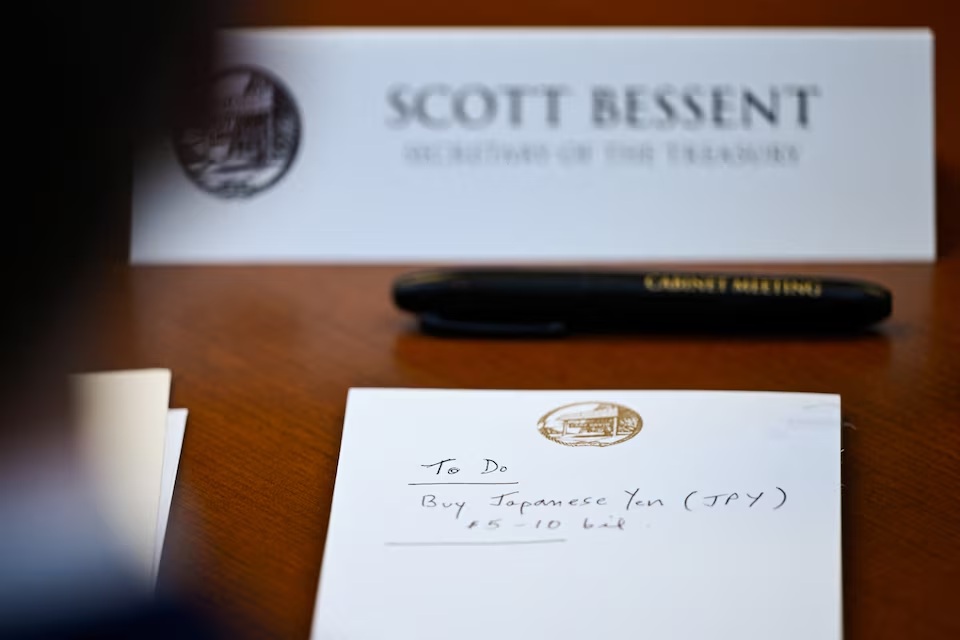
The Bank of Japan and the US Treasury combined to make an unprecedented Yen intervention last week.
But why?
What are the systemic risks at play? And will the market behave how Scott Bessent intends? Or will there be unintended consequences?
We continue our series of discussions to Watch Japan. This continues a prophetic series of events connected to the shaking of USD-based financial markets and Western economies.


Kingdom of God

We care about this because as believers in a greater Kingdom (the Kingdom of Heaven) we want to know the times and the seasons (like the sons of Issachar – 1 Chronicles 12:32) and stand prepared on the Rock of Christ.
Not on the sifting sands of Babylon. Hence we pursue the Storehouse Strategy, by removing dependency on serving or trusting in money (Matt 6:24).
#1 Contageon Risk – US Treasurys

Japan is the world’s largest single owner of US Treasuries, at $1.13 trillion. The natural course is for the BOJ to sell UST and use the dollars to buy Yen to defend the currency. The problem is the BOJ tried that earlier this year and it failed. They spent $73Bn USD without lasting success. Goal being 160 JPY/USD. The market knows that the BOJ lacks the firepower without a fire sale of UST. Hence, this unprecedented dual intervention attempts to avoid that outcome.
Will it work this time?
This, coupled with Bessent lobbying the Fed to increase an emergency $60Bn UST FIMA Repo facility originally designed to provide liquidity during crisis to foreign governments looking to raise USD.
Only the Federal Reserve itself owns more UST at $4.5Tn. The US Federal debt is now $40Tn. Critically, the 30-year is above 5% and the JGB 30-year is almost 4%. Both UST and JGB interest is a massive cost on both governments and economies. USA is 125% Debt to GDP and Japan 235%. Demand for new issues is soft.
The US Administration has a three-fold monetary objective:
- strong dollar to temper inflation,
- lower interest rates, and
- re-shore manufacturing jobs.
The problem is that the US can realistically achieve only two of these three objectives. So, which one will Bessent / Warsh sacrifice?
#2 Risk – Yen Carry Trade

We covered the Yen Carry trade in our 2nd BOJ Raise Discussion back in August 2024. Briefly, it involves borrowing in Yen where interest rates are lower and investing the proceeds in USD assets. In the original versions of the carry trade the proceeds were invested in high-yield debt.
In the more recent version of this trade, people borrow in Yen to invest in US stocks, which are dominated by A.I. stocks (see point #3 below). Obviously, this is a riskier trade because any individual stock can go to $0, whereas bonds almost always trade at a discount but doesn’t usually become completely worthless.
In one analysis I ran, there may be a 30-35% chance the carry trade blows up within a year and a 55-60% chance in the next 3 years.
What precipitates such a blow up? When people no longer want to pay Yen interest (JGB yields go up) or the JPY/USD moves the wrong way (JPY/USD strengthens much more than 160). Then, things usually cascade from there as investors sell US risk assets to cover their Yen bets and loans. This of course happened once recently in August 2024 when the global markets dropped nearly 20% and the Yen strengthened. However, the carry trade has crept back and the pattern is poised to repeat.
#3 Risk – A.I. Stocks

So, it goes without saying that AI valuations right now are historically as high as they have ever been. The market is also highly concentrated in AI stocks (literally 50% of the entire stock market’s value by many measures). We discussed this in detail back at the end of 2025 in the A.I. Bubble Discussion. This includes Michael Burry’s thesis of GPU depreciation accounting. And circular revenue streams.
#4 Risk – A.I. Private Credit

One of the largest segments receiving private credit loans is tech. This includes legacy tech, such as software companies and cloud computing (vintage early 2020s) and the new tech which is AI (more recent).
One of the issues in private credit is when a company either can’t or doesn’t want to pay interest; they often negotiate and invoke a PIK option (payment in kind). That is where you don’t pay the interest, you just stuff it into the loan’s principal. As a result, the interest rate levels up higher, and the compounding effect exacerbates the chance that the loan ultimately never gets repaid.
When a company is distressed this is called “bad” PIK (think the software companies of early 2020). When a company is “hot,” they negotiate it into their loan deal (“good” PIK) and use it to avoid draining cash before profitability (think recent AI datacenter build out for Anthropic, OpenAI).
Given our discussion of Troy Black’s “a financial giant will fall” as part of his private credit word back here: Private Credit Discussion, we need to understand there may be a further failure of an institution much larger than MFS earlier this year.
This could be similar to how Bear Stearns had problems that should have remained internally contained within its 2 hedge funds back in 2007, but it led to a crisis of confidence in the entire firm’s credit, quickly spinning out of control into a failed bank. Meaning KKR, Blackstone or even Blackrock’s private credit funds could cause a ripple effect on to the liquidity / solvency of the larger institutions.
PIKs could be analogous to Option ARMs of the 2008 financial crisis.
Cascading Effect – Perfect Storm?
If these events cascade—the carry trade blows up, leading to an AI meltdown, then a Private Credit implosion of banks and insurance companies—the problem compounds into a type of “Perfect Storm”. There are precedents for this. The 1997/98 Asian debt crisis and the subprime meltdown. The 2008/09 financial crisis. The 2020/01 pandemic.
Related to all this is a YouTube follow-up to the Yen word Troy Black had back in 2025 which we discussed here: Troy Black Yen Word.
Troy Black: God Showed Me a Financial Crisis Starting in Japan
We drafted a white paper entitled: The Perfect Storm: Where the Yen, Private Credit, and the AI Trade Actually Connect if you are interested in more detail about some of the prophecies and risks to the financial markets.
Update
Since we discussed this, the SEC clarified that AI private credit securitizations were not classified as asset-backed securities. What that means is the AI private credit debit is unregulated. None of the financial reforms of Dodd Frank or otherwise post 2008 financial crisis applies.
We also incorporated some of Andrei Jikh’s research regarding the captive insurance side. Turns out its even worse than we assumed, and much of the risk of AI debt is now being moved offshore through opaque Bermuda based reinsurance vehicles. Further, most state insurance regulators have a bailout structure in place that ends up getting passed along to citizens via tax credits. Who knew?
What’s perhaps even more interesting is, he confirmed what we had prognosticated in the “Perfect Storm” document about some 9 days prior to this video being published, that there is a real risks of the Yen/Treasury/AI Bubble/AI Private credit combining together to cause a problem. Find the updated (and now paginated) version here: Perfect Storm v1. 2
Leave a Reply